

Underwater & Subsurface Communication
The Industry Problem
Conventional Communications (RF) Struggle in Conductive Environments
Because conductive materials rapidly degrade signals, traditional electromagnetic (RF) communications are ineffective in seawater, dense biological tissue, and metal enclosures. The energy loss and skin-effect absorption of high-frequency waves in these mediums make conventional wireless devices inefficient.
As a result, many systems rely on:
Sonar
Acoustic communications
Tethered infrastructure
These methods can betray position, cause interference, or have restricted bandwidth.


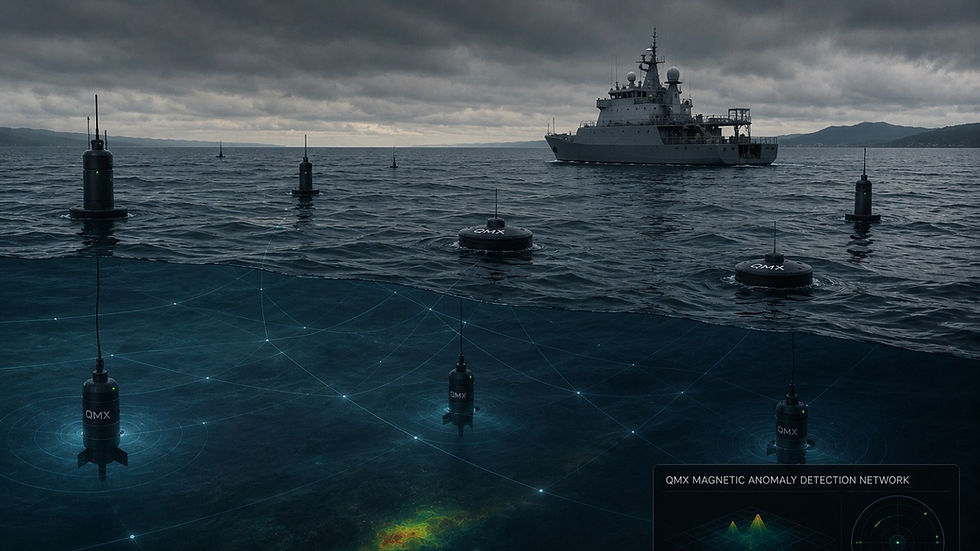
What QMX Enables
Magnetic Communication Pathways
QMX is investigating the use of low frequency magnetic fields for:
Underwater commkunications
Subsurface communication
Robotic coordination
Subsea sensing networks
Low probability of interception links
Critical mineral detection
Subsurface anomaly mapping
Potential applications include:
Maritime defence
Offshore infrastructure
Mining systems
Subterranean robotics
Distributed autonomous networks
QMX seeks to investigate communication solutions appropriate for settings where standard RF systems are ineffective.